This article is part of the series which traces the origins of Woolwich Arsenal FC and its ultimate move to Highbury. An index of the articles from the very start of the series is published here , and details of how this links in with our other now series on the history of Arsenal can also be found at the end.
Our recent posts
- Planning the revolution: Arsenal move from Plumstead to Highbury
- Arsenal’s chairman announces the idea Arsenal’s possible move to north London
- How Tottenham worked to stop Arsenal moving to Highbury
By Tony Attwood
Amidst the excitement of Arsenal moving from south London to Highbury one thing was not particularly noticed – and that was the football. Undoubtedly because all funding went into the building of the new ground (funding that came primarily from Henry Norris), there was no money left to improve the football team and so 1912/13 – the year when the move began – was Woolwich Arsenal’s worst ever season. The club came bottom of Football League Division One, winning just three games, drawing 12 and losing 23.
The crowd for their last game at the old ground in Plumstead on 26 April 2013 was just 3000 as Woolwich Arsenal drew 1-1 with Middlesbrough. It meant Woolwich Arsenal had not won any of their last eight games in south London, and with a crowd that low there was no special farewell commemorations. And the end of the game the players just trooped off the pitch.
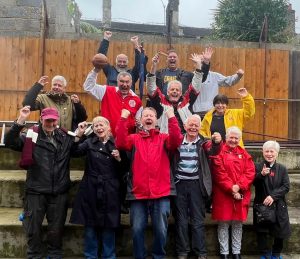
And if I might add an aside, a few years ago the Arsenal Independent Supporters Association organised a visit to where the original Plumstead ground stood. You can find a map of the site on one of our previous reviews.
Indeed one of the householders there incredibly kindly allowed us to tramp through his house into the back garden, where we could stand on some of the original terracing of Woolwich Arsenal FC. It was, for me, and I think, for all of us there, a most extraordinary, and dare I say, moving, experience, and I for one am eternally grateful both to AISA and to the householders for allowing us to stand on the historic origins of the club we all support.
But at the time of Arsenal’s move from Plumstead to Highbury, not much attention was given to the past because no one could quite believe that any group of workmen could transform a field into a ground capable of holding a professional football match in such a short space of time.
And quite how 20,000 could get into the “mud-based terraces” as they were described is unclear. But what was clear was that Norris had not lost his ability to make headlines and keep up the interest in Arsenal and its remarkable move. For not only did the club make the ground ready for its first game on 6 September 1913, Arsenal also signed Jock Rutherford, an England international! It was clear that Norris was utilising the marketing skills that had brought him his fortune through house building. He clearly knew, as I believe all business people know, you always have to get the main activity right, but there also always has to be more.
Norris had indeed been right about the crowds coming to Highbury and as the ground improved and the word got around the crowds grew bigger and bigger. Indeed the scheduling of matches was also kind to Arsenal for close to the end of the season which much of the stadium by now completed, Arsenal had the derby match with Clapton Orient. It saw the crowd total 35,00 for the first time. These numbers were of course estimates, but if anything they would have been under-estimates given that tax was to be paid on the income the games produced! No clubs exaggerated their “gates” just to give more to the government.
This home game was indeed an interesting comparison that the final game of the season – away to Glossop – only saw a crowd of 4,000 turn up. Arsenal were now getting numbers that placed them if not in the elite, then certainly getting very close to it. And as the word spread, so other clubs started to wonder if they too might not move to a larger, more modern ground closer to their rivals. For the maths was clear – if the circumstances were right and the grounds were close, matches against local rivals could bring in six or more times the normal crowds for clubs used to small gates.
Arsenal had hoped for a quick return to the 1st Division. However on the footballing front Arsenal did not get promoted in their first season back in the second division, for they finished the campaign just one step outside the promotion spots, in third place. They had the same number of points as Bradford PA but missed out on goal average – a calculation made by dividing goals for by goals against.
The system of goals for divided by goals against had been created somewhat arbitrarily, and actually helped clubs with better defences rather than those with better attacks. Had the system been worked on the basis of goals against divided by goals for, Arsenal would have come above Bradford PA and gone straight back to the top league. The modern system of goals for minus goals against (known as goal difference) would however have given promotion to Bradford, and so we can’t really complain.
Final League table
| Team | P | W | D | L | F | A | GAv | Pts | |
|---|---|---|---|---|---|---|---|---|---|
| 1 | Notts County | 38 | 23 | 7 | 8 | 77 | 36 | 2.139 | 53 |
| 2 | Bradford PA | 38 | 23 | 3 | 12 | 71 | 47 | 1.511 | 49 |
| 3 | Woolwich Arsenal | 38 | 20 | 9 | 9 | 54 | 38 | 1.421 | 49 |
| 4 | Leeds City | 38 | 20 | 7 | 11 | 76 | 46 | 1.652 | 47 |
Indeed in many ways this outcome was reasonable given that the club only scored 54 goals in the season, while those above and immediately below in the top four all scored 71 or more.
But by the end of the season that was hardly the main thing on people’s minds for in the summer events nationally took what could only be described as “a turn for the worse” On 28 June 1914 Archduke Franz Ferdinand, heir to the Austro-Hungarian throne, was killed. On 28 July Austria-Hungary declared war on Serbia, and the first world war was initiated.
These dates meant that many people expected football to be ceased, and indeed Henry Norris found himself an early beneficiary of developments as he now had a buyer for the old stadium – the government took it over as a location for the manufacture of armaments.
But with the players under contract to their clubs, and no formal arrangements existing within those contracts for what should happen should the country go to war, no one was quite sure what would happen next. Indeed with no one (obviously) having any idea how long the war would last (the expectation among many was it would be “over by the spring”) football continued.
And thus 1914/15 was the one and only time professional football was played in England during a world war. The legal argument that seemed to determine the matter was that players were under contract to their clubs, and there was nothing in their contracts that would override their contracts in the case of war. No one wanted a raft of court cases, and with the government no announcing a formal policy, life at home continued.
Henry Norris, although dutifully offering himself in the service of his country seems to have been considered as “not one of us” by the officer elite given that he was involved in what were considered “non-professional” trades such as football and house building, and so when he volunteered he was given somewhat derisory rank of second lieutenant in the 2nd Tower Hamlets Rifles Volunteer Brigade. But there are no signs that he made any complaints – he accepted his duty and got on with it.
Indeed reports suggest that the public school educated elite who ran the military at the time had no idea what rank to give to a man who was very much in the public eye as the builder of Fulham the chair of Arsenal, and the man who had taken on the whole football league over the issue of where clubs could play – and indeed a man who was clearly something of a hero to at least half of north London.
Upon volunteering, when football was stopped for the duration in 1915, he again seems to have caused those who allocated rank and position to civilians, a problem, and was ultimately given the job of military recruitment officer with the somewhat derisory rank (given he past) of Lieutenant. That he was a Lieutenant Colonel by the end of the war shows just how derisory his initial treatment was. He was very much a man who had “not gone to the right school” and so was initially dismissed as not being worthy of attention. Being involved in football clubs didn’t help him either!
Conscription did not come into force until 1916 and the football league season of 1914/15 was played to a conclusion and Arsenal were designated as having finished in sixth position on goal average. In fact the position was miscalculated, but this being war time, and no footballing issue being dependent on the outcome of the season, the matter was not amended for over half a century. In fact had the calculaition been done properly Arsenal would have been placed fifth, but since there was no prize money for coming below second, no actual harm was done to the club.
Derby County and Preston North End were designated as being promoted to the 1st division, although of counse no one had any idea when professional football might return. All they knew in relation to Arsenal was that Arsenal would be in League Division Two, and would play at Highbury, so long as it did not suffer war damage which made that impossible.
But of course there was wartime football, to entertain the troops on leave and those who were not called up because of age or the nature of their essential work. We’ll turn to Arsenal in the first world war in the next episode.
However you will of course already know that once the war was over, the 1st division of the Football League was expanded and Arsenal were elected to the 1st division. Because not everything is always written in the most logical order we have already covered that later part of Arsenal’s history – under the logical heading 100 seasons in the top division.
.
